A Spiritual Journey through Tibet

Posted on December 26th, 2007 in Buddhism, Religion, Travel by Rodica

I was watching a documentary on the Tibetan Book of the Dead. At some point you could see the interior of a room, where a few Tibetan monks started the ritual following the death of a young Tibetan. The room did not have windows, only openings in the stoned wall. But the openings were covered by very small curtains.

As always, I was overwhelmed by the austerity of the Tibetan life, and again I promised myself that one day I will go there. Maybe I am not spiritual enough for this type of journey but I am pretty sure that I would have a life transforming experience.

What do you feel watching this picture?
tibet-young-and-old.jpg
Photo courtesy of Konstantin

First glimpse brought me a huge emotional pain; my soul hurt. I could almost hear the eerie sound of the wind. The wind that burnt the faces of the old and young Tibetans for centuries.

The most popular image people would refer to while thinking of Tibet, beside the Chomolangma naturally, it’s the artifact found on top of Jokhang (The House of Lord) Temple.
Deers are a direct reference to the Buddha’s first teaching in the Deer Park, Sarnath, also called Dharmachakra Parivartan. The suggestion is that his presence was so peaceful that even the animals came to listen.
In the Tibetan tradition, a monastery which holds the Kangyur and Tengyur collections of texts would have this symbol of deers on both sides of the Dharma-wheel on the roof.
tibet-roof-jokhang-temple-500.jpg

The Jokhang Temple is the most celebrated temple in Tibet. Because the temple is not controlled by any sect of the Tibetan Buddhism, it attracts followers of all the sects, along with the followers of Bon Po, Tibet’s indigenous religion.
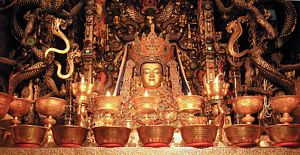
The Temple houses the most sacred artifact of the Buddhism: the statue of Jowo Sakyamuni or Gautama Buddha, the founder of the Buddhism.
tn_tibet-jawobuddha.jpg
The statue is 1.5 meters tall, cast from precious metals and decorated with jewels and it represents Sakyamuni when he was twelve-year old.

The Tibetans continue to be violently repressed by the Chinese. Hundreds of Tibetan monks are still imprisoned, vast areas of the country, which are off limits to foreign visitors or journalists, are stripped of natural resources and most monasteries in desperate need of reconstruction are left without any financial support by the Chinese government.
Some monasteries, part of the tourist circuit, have been more or less given reconstruction assistance.
Not Tashilhunpo.
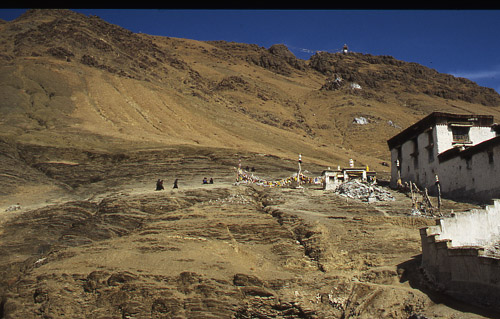
But Tibetan pilgrims still visit this ancient holy site to access the spiritual presence and to pray for the spirit- health of the monastery, spirit to be said to return only after the departure of the Chinese.
The ritual asks to follow clockwise the sacred path, outside the walls.
pilgrimcircuit.jpg
Photo courtesy of Konstantin

Tashilhunpo remains one of the poorer monasteries, but one that is still trying to look after the physical, mental and spiritual well-being of all the monks, throughout their lives.

I found this very interesting site, that promises a meaningful trip to Tibet.


Abulafia and Umberto Eco

Posted on December 23rd, 2007 in Religion, Books by Rodica

I was watching the other day a documentary about Kabbalah and at some point the name Abulafia came up.
Suddenly I remember where I’ve read it before: in Umberto Eco’s Foucault’s Pendulum.
Interesting how things are connected in life.

In Foucault’s Pendulum Abulafia was the nickname of Belbo’s computer used by him and two other friend-editors to decipher the hidden coded manuscript alleged to contain the information on how the Templar Knights planned to take over the world.
When I’ve read the book, I was intrigued by the name, but that was all. I was too much preoccupied on trying to navigate the intrigue to give a second thought to this name. The book it’s not an easy reading but the journey through the labyrinth it’s quite interesting.

Who was Abulafia?
Abraham Abulafia (1240-1294) is the most important figure in the prophetic Kabbalah.
As opposed to the most known Kabbalist who lived a normal conventional family life, Abulafia was the wandering mystic and teacher, moving from town to town, spreading his teachings.
Abulafia teaches that, by using his methods of letter permutation, meditation, and free association, you can receive prophecy today. Naturally, the Thorah scholars are not quite happy with the mystical point of interpreting divine words.

Before my son was born, I tried to find a meaningful name for him. I came across a Kabbalarian analysis of names and it took me a few days to find one that seemed to work well with the last name and I liked as well. Nowadays everybody knows about artists embrassing Kabbalah, but without converting to Judaism, which is a point various rabbies are complaining about. Probably Abulafia opened Pandora’s box with his teachings.

Finally, what is Foucault’s Pendulum?
The Pendulum is made of a support, a wire and an iron ball that swings back and forth in a plane that is fix relative to the distant stars. Because of the Earth rotation, it will appear that the pendulum rotates anti-clockwise describing a full circle within 24 hours period.


Bible “sayings” debunked

Posted on December 3rd, 2007 in Myths debunked, Religion by Rodica

Common phrases known as sayings from the bible:

The yellow race will inherit the earth.
Actually it is from Nostradamus Prophecies.

The closest reference to the bible is a pretty convoluted interpretation:
“Revelation 9:13-16:The sixth angel sounded his trumpet, and I heard a voice coming from the horns of the golden altar that is before God. It said to the sixth angel who had the trumpet, “Release the four angels who are bound at the great river Euphrates.” And the four angels who had been kept ready for this very hour and day and month and year were released to kill a third of mankind. The number of the mounted troops was two hundred million. I heard their number. “I guess at that time China had the biggest army.

“God helps them that help themselves”
It’s actually :
“The gods help those who help themselves” from Aesop’s fable “ Hercules and the Wagoner” written sometime in 550 BC

HERCULES AND THE WAGONER
by Aesop
A wagoner was once driving a heavy load along a very muddy way. At last he came to a part of the road where the wheels sank halfway into the mire, and the more the horses pulled, the deeper sank the wheels. So the Wagoner threw down his whip, and knelt down and prayed to Hercules the Strong. “O Hercules, help me in this my hour of distress,” quoth he. But Hercules appeared to him, and said:
“Tut, man, don’t sprawl there. Get up and put your shoulder to the wheel.” -
The gods help those who help themselves.”

“Cleanliness is next to Godliness”
“The book of Leviticus frequently deals with the issue of cleanliness and impurity so that the Children of Israel would be clean as a sign of separation from the surrounding nations. Yet in the New Testament, cleanliness finds mention in relation to the cleansing of the believer’s life”
Source: http://www.blueletterbible.org/faq/sayings.html

“Moderation in all things”
“Attributed to Aristotle (384-322 BC) who espoused the doctrine of the golden mean (shared independently by Confucius) that the best path in life was the one between two extremes. It has come down to us as ‘moderation in all things’.”
Source: Richard Sorabji

“Love the sinner and hate the sin”
It’s a quote from Augustine’s writings:
“Love the sinner and hate the sin” (Cum dilectione hominum et odio vitiorum) (Opera Omnia, vol II. col. 962, letter 211.), literally “With love for mankind and hatred of sins ”

“Money is the root of all evils”
“This expression stems from the biblical phrase that says, “For the love of money is a root of all kinds of evils” (1 Timothy 6:10). There is a big difference between the two statements. Money is neutral and can be used either for the good or for the bad. Money of itself is not evil, yet the love of it is the root of all kinds evil”
Source: http://www.blueletterbible.org/faq/sayings.html#money

“The lion shall lie down with the lamb”
“This is a popularly misquoted passage from Scripture. From filtering into pop culture to influencing Christian kitsch, the image of a lamb sweetly nestled into the side of a powerful lion is one that resonates. We are often asked from where comes this image.

The image has developed from a different juxtaposition of animals in a couple verses from the writings of Isaiah. In these verses, both lions and lambs appear but are paired with other animals.

Isaiah 11:6
The wolf shall dwell with the lamb, and the leopard shall lie down with the young goat, and the calf and the lion and the fattened calf together; and a little child shall lead them.

Isaiah 65:25
“The wolf and the lamb shall graze together; the lion shall eat straw like the ox, and dust shall be the serpent’s food. They shall not hurt or destroy in all my holy mountain,” says the Lord.”
Source: http://www.blueletterbible.org/faq/sayings.html#money

Ancient religious ceremony: The Whirling Dervishes

Posted on November 23rd, 2007 in Religion by Rodica

First time when I have heard about the Whirling Dervishes I was watching Amazing Race 7 . On Episode 9 the teams travelled to Istanbul, Turkey; the next episode brought them to a place where the whirling dervishes presented their ritual. Leaving the dervishes, Uchenna exclaimed, “Wow, that was magical.”

Now, the Whirling Dervishes are coming to Vancouver, on Saturday November 24, 2007 at Chan Centre.
The Mevlevi Order, or Whirling Dervishes as known by the West will present their ritual rite of Sema.
The emphasis is on the word ‘ritual’, because it’s not going to be a performance, or a dog-and-pony show.

The Order of the Whirling Dervishes is one branch of the vast Sufi tradition of Islam. The universal values of love and service shared by all Sufis are very much relevant to the social and political realities of today, and this ritual, which is only performed by the Order of the Whirling Dervishes, has come to symbolize these values in the hearts and minds of millions throughout the world.
Sufism espouses a well-founded and thoroughgoing interpretation of Islam, which focuses on love, tolerance, worship of God, community development, and personal development through self-discipline and responsibility. A Sufi’s way of life is to love and be of service to people, deserting the ego or false self and all illusion so that one can reach maturity and perfection, and finally reach Allah, the True, the Real.

One Sufism principle I found very interesting:
“ Being able to discern what is in hearts or minds through facial expressions and the inner, Divine mysteries and meanings of surface events”
More about Sufism and it’s origin here
whirling-dervishes.jpg
To find more about sema ritual, let’s go to the source

THE SEMA RITUAL began with the inspiration of Mevlâna Jalâluddîn Rumi (1207-1273) and was influenced by Turkish customs and culture.
It is scientifically recognized that the fundamental condition of our existence is to revolve. There is no being or object which does not revolve, because all beings are comprised of revolving electrons, protons, and neutrons in atoms. Everything revolves, and the human being lives by means of the revolution of these particles, by the revolution of the blood in his body, and by the revolution of the stages of his life, by his coming from the earth and his returning to it.
Thus the whirling dervish or semazen, intentionally and consciously participates in the shared revolution of other beings.
Contrary to popular belief, the semazen’s goal is not to lose consciousness or to fall into a state of ecstasy. Instead, by revolving in harmony with all things in nature — with the smallest cells and with the stars in the firmament — the semazen testifies to the existence and the majesty of the Creator, thinks of Him, gives thanks to Him, and prays to Him. In so doing, the semazen confirms the words of the Qur’an (64:1): Whatever is in the skies or on earth invokes God.
An important characteristic of this seven-centuries-old ritual is that it unites the three fundamental components of human nature: the mind (as knowledge and thought), the heart (through the expression of feelings, poetry and music) and the body (by activating life, by the turning). These three elements are thoroughly joined both in theory and in practice as perhaps in no other ritual or system of thought.
The Sema ceremony represents the human being’s spiritual journey, an ascent by means of intelligence and love to Perfection (Kemal). Turning toward the truth, he grows through love, transcends the ego, meets the truth, and arrives at Perfection. Then he returns from this spiritual journey as one who has reached maturity and completion, able to love and serve the whole of creation and all creatures without discriminating in regard to belief, class, or race.
In the symbolism of the Sema ritual, the semazen’s camel’s hair hat (sikke) represents the tombstone of the ego; his wide, white skirt represents the ego’s shroud. By removing his black cloak, he is spiritually reborn to the truth. At the beginning of the Sema, by holding his arms crosswise, the semazen appears to represent the number one, thus testifying to God’s unity. While whirling, his arms are open: his right arm is directed to the sky, ready to receive God’s beneficence; his left hand, upon which his eyes are fastened, is turned toward the earth. The semazen conveys God’s spiritual gift to those who are witnessing the Sema. Revolving from right to left around the heart, the semazen embraces all humanity with love. The human being has been created with love in order to love. Mevlâna Jalâluddîn Rumi says, “All loves are a bridge to Divine love. Yet, those who have not had a taste of it do not know!”

Faith Crisis: The God Who Wasn’t There

Posted on November 10th, 2007 in Religion, Movies by Rodica

“Religion is regarded by the common man as true … by the wise as false … and by the rulers as useful.”Seneca, Roman Philosopher

Within our perceived and tangible existence we could find ourselves at a spiritual crossroads: Does God exist? Was Jesus real? By ‘we’ I am talking about the open-minded people who would not necessary adopt the truism way of thinking, who are not brain washed and more than anything who would really like to get some answers.  Sometimes I envy the people who are very confident in their beliefs. The atheist who believe there is nothing out there, and after we die it’s nothing left, other than us becoming dust. Or the hardcore religious guys who believe that there is an omnipotent, ubiquitous somebody (namely God) who punishes according to your sins or the wrongdoing of your ancestors. I am none of them. There is a part of me who believes that there is something out there. We are created of energetic particles and we cannot just vanish. If we are to find answers, we have to investigate pros and cons literature.

 I was born and raised Christian Orthodox and it’s absolutely nothing spectacular about this religion.

 I will not define myself as not being spiritual. Just that Christianity left me with a bitter taste in my soul. My quest has not stopped.

The next stop in my spiritual journey is to try to understand the atheistic point of view.

I guess one of the reasons the skeptics are looking for proofs is to counteract the forced feeding coming from the righteous.

 One of the movies that created some buzz is The God Who Wasn’t There . I went looking for reviews about the movie on the Internet. Following are some of my findings:

Claims  made by Flemming and interviewees in The God Who Wasn’t There include:

  • The divine Jesus was based on older, mythic “savior figures” such as Dionysus and Mithras and that Christian leaders are reluctant to teach early church history because it supports, rather than debunks, the theory that Jesus was a mythic figure rather than a historic personage.
  • Earlier gods like Thor, Balder, Deva tat, Dionysus, Bacchus and Horus shared one or more similarities to Jesus, including “Born of a virgin on December 25″, “Killed on a Cross or Tree”, “Visited by Magi from the East”, “Rode Donkeys into the City” and “Betrayed for 30 Pieces of Silver”.
  • Christianity’s global success is based on its claim to historical accuracy. Unfortunately for the Christian church, the “proof” evaporates on closer scrutiny.
  •  The film opines that modern Christians aren’t taught about early history of their religion because, upon any real scrutiny, evidence of Jesus’s life evaporates.
  • Moderate Christianity makes even less sense than a fundamentalist interpretation of Christian doctrine because the Bible contains many messages incompatible with toleration of non-Christians, particularly Jews (who reject Jesus as a savior and, thus, are damned).
  • Christian doctrine is contradictory in details but unambiguous on one point: God demands you believe in him or be damned to eternity in hell. Flemming sees this as, essentially, mind control.

Searching for other arguments, I found these clarifications on some of the arguments used by Flemming to support his theory:

Born of a virgin on December 25 - None. And according to the Gospels, not even Christ. Mithras was formed from a rock on Dec 25, but this date doesn’t appear to predate Christ.

Stars Appeared at Their Births - Krishna

Visited by Magi from the East - None

Turned Water into Wine - I’ll put Dionysus here, though there is no myth where he does it himself. In one story, empty jugs left in a Dionysus Temple miraculously fill with wine overnight. In another story, a devotee causes a spring of wine to appear. In neither case is “water turned into wine” — wine only gets created. (Again for those who want to quibble: I am going with the wording presented. I suspect “turned water into wine” is worded that way to bring up the image of Christ personally performing that miracle. Why not just say “Wine gets miraculously created”, which would be a match?)

Healed the Sick - Asclepius, a few others, especially when believers prayed to them after they ascended to heaven.

Cast out Demons - Krishna, Buddha

Performed Miracles - Several 

Transfigured Before Followers - None.

Rode Donkeys into the City - None. Dionysus is depicted riding on a mule, though not into a city. (What? Close enough, you say? Then why not say “Rode a beast of burden to some place for some reason”? Then it would be a match) 

 Betrayed for 30 Pieces of Silver - None (though I’ve heard this is true of Socrates)

Celebrated Communal Meal with Bread and Wine - Mithras 

Which (Celebrated Communal Meal) Represented the Saviour’s Flesh and Blood - None

Killed on a Cross or Tree - None

Descended into Hell - Dionysus

Resurrected on Third Day - Attis (though the evidence for this doesn’t appear to predate Christ)

Ascended into Heaven - Lots! (Not sure where else gods are supposed to go)

To Forever Sit beside Father God And Become Divine Judge - None (Osiris and Mithras do become judges, though don’t sit beside a Father God) 

From the same source it comes the following information: 

Richard Carrier says in the movie:

“You have someone make up a fake quote, or misrepresent a document, misrepresent the evidence. [Readers] assume: “This guy wouldn’t lie. He wouldn’t have made this stuff up.” And so they go and repeat it. And so you get the lie repeated many times mostly by people who aren’t lying - they really do think it’s true. They just didn’t check.”For me, Carrier’s statement summarizes the data content of Flemming’s movie. Flemming has presented misinformation on pagan “saviour figures” that is repeated uncritically from website to website. From the reviews on atheist websites, many people have just accepted this misinformation as fact. After all, Flemming wouldn’t lie. He wouldn’t have made this stuff up. But unfortunately he just didn’t check. And, while it is true that Paul gives few historical markers in his writings, Jesus Mythers rarely (if ever) attempt to examine that pattern within the context of the literature of the day. Again, there doesn’t appear to be any checking… which brings up this point: What are Flemming’s sources? Where did he get his information from? While I can’t criticize him for including references to his sources in the movie, it has been a year since he has released it, and the research that he said he did has been slow in coming forth. And why no follow ups with interviews with other scholars on some of these points? There are actually a number of Jesus Myth variations, with Earl Doherty’s version the pre-eminent one currently. All Jesus Myth proponents believe that their particular view remains unrefuted, though obviously not all Jesus Myth theses can be correct at the same time. (This is of course a similar situation that religions find themselves in). Which one is the “true” Jesus Myth theory? Flemming appears to have adopted Doherty’s version (with a dash of Acharya S or Freke&Gandy), though I doubt that he has investigated Doherty’s thesis in any more depth than he investigated Christian origins when he was a fundamentalist. Finally, I should point out that the reviews of Flemming’s movie on atheist websites have generally accepted it on good faith — and generally uncritically. I hope that my analysis encourages a more skeptical attitude towards Flemming’s movie. I think I’ve presented a strong case that the claims made in the movie should at the least be examined on their merits, rather than assumed to be true. But it is worth pointing about again that I am a Christian, so I may be biased. I urge interested readers to look into claims for themselves, and not take my word or Flemming’s word for anything. What about the evidence for a historical Jesus? Well, that isn’t very strong either. But currently scholars — both religious and secular — appear to believe that they have enough evidence to come to a conclusion. And until mythicists start to present their cases in peer-reviewed publication, the current consensus that there probably was a historical Jesus at the core of Christianity is a reasonable position based on standard practice of conducting historical research.”